Oranjezicht Blinds / Products / Concealed & recessed
Concealed blinds for the glass you added
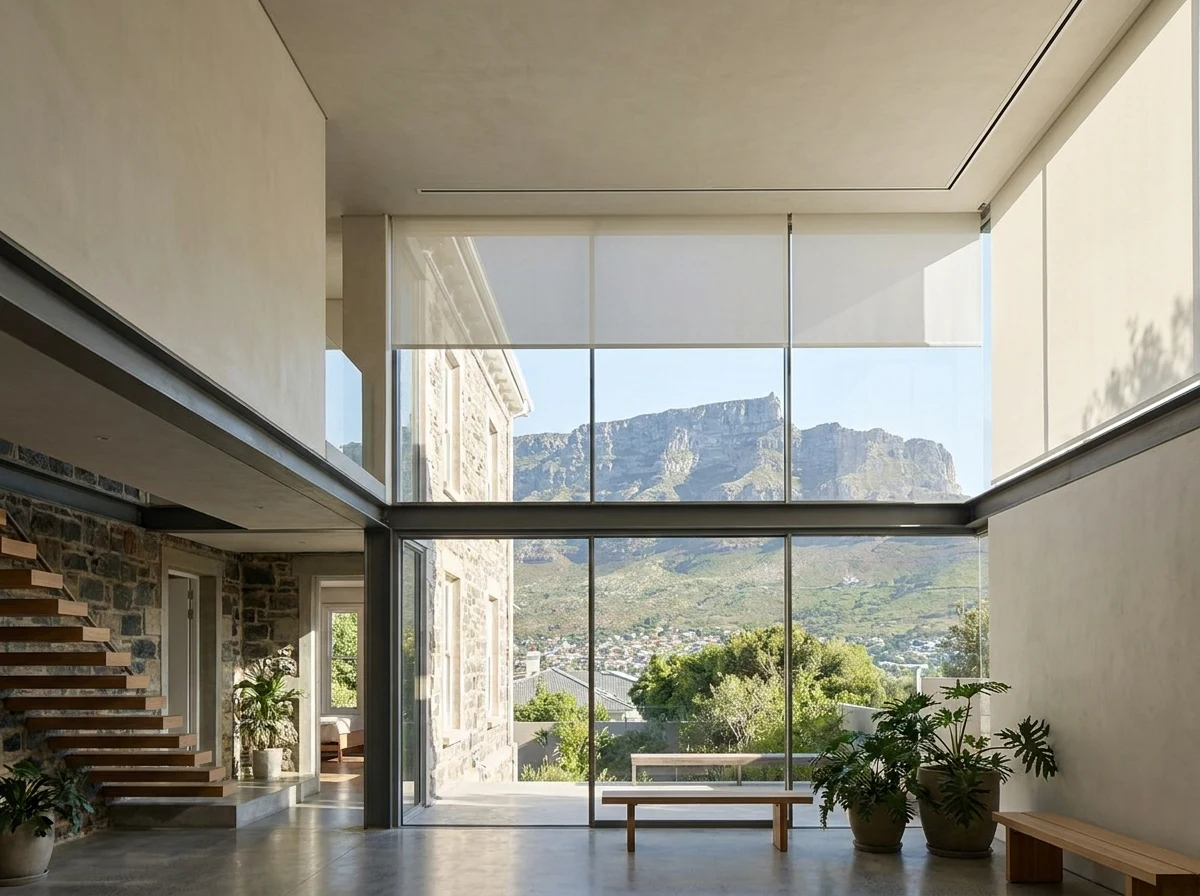
Designed into the ceiling rather than bolted onto it — raised, the window shows nothing but glass and frame.
The blind that isn’t visible when it isn’t needed
A concealed system drops the fabric from a slim slot in the ceiling or a plastered bulkhead, so the hardware is fully hidden. When the blind is up, the glass extension behind an Oranjezicht facade reads exactly the way the architect drew it — glass, frame, and nothing else. When it’s down, the shading is doing its job without a bracket or fascia in sight.
This is the system we spec for the double-volume glass additions we see behind original heritage frontages block after block — the extension the architect fought to keep clean-lined, where a surface-mounted roller headrail would undo the whole idea.
What the recess actually needs
Recess depth
Roller systems typically need 110–150mm depth depending on tube and fabric drop. We confirm exact specs per system at quote stage — never guessed on site.
New build or renovation
The earlier we’re involved in the drawing stage, the cleaner the result — the recess is planned into the ceiling before it’s closed up.
Retrofit option
Where the ceiling is already closed, a surface bulkhead or a slim cassette pelmet colour-matched to the ceiling gets close to the same clean line.
Coordination
Downlights, aircon slots and curtain pelmets planned alongside the blind recess, so nothing collides at fitting stage.
Almost always motorised, and here’s why
- A hand-reach into a ceiling slot defeats the point of a concealed system — motorisation is close to a given, not an upsell
- Wired or rechargeable-battery motors depending on whether the ceiling is open at build stage or already closed
- Multi-blind glass walls run off one switch or one app scene — no chain hanging down a floor-to-ceiling pane
- Fabric choice still does the same work as any roller — sunscreen for the mountain view, blockout where the room needs real dark
The addition that respects the original front rooms
A common Oranjezicht brief: keep the Victorian or Edwardian street face untouched, and build a glass-walled kitchen or living extension at the back that opens onto the garden and, on the right stand, onto Table Mountain itself. That extension almost always means a double-volume void or a frameless corner — exactly the opening a concealed recess was designed for. Because the shading system lives inside the new build rather than fixed to the outside of the original structure, it sits outside the Heritage Protection Overlay Zone permit process that governs changes to the exterior of a building older than sixty years.
The wind still matters even indoors here — a glass wall this size heats and cools fast with the City Bowl’s swing between a high summer sun and a low winter one, so the fabric choice on a concealed system is not a decoration decision, it’s a comfort one.
Concealed systems across the City Bowl
The same architect-glazing brief comes up on Higgovale’s mountain-slope builds, Tamboerskloof renovations, Gardens apartment conversions and Vredehoek’s modern blocks.
Worth knowing before the measure
Our extension is already built — is it too late for a concealed blind?
Not necessarily. A surface-mounted bulkhead or a slim cassette pelmet, colour-matched to the ceiling, gets close to the same clean sightline without opening up the ceiling. It won’t be quite as invisible as a true recess planned at drawing stage, but most clients find it does the job.
How much ceiling depth do we actually need to leave?
Roller systems typically need 110–150mm depending on tube diameter and fabric drop. We confirm the exact figure for your specific system at quote stage rather than quoting a generic number that might not fit your ceiling build-up.
Does a concealed system need to be motorised?
Almost always, yes — there is no hand-reach into a ceiling slot. Battery or wired motors both work; which one depends on whether we’re specifying before the ceiling closes or retrofitting after.
Other things we fit in Oranjezicht
What a concealed system costs in Oranjezicht
A recessed blind is partly a building detail, and it is priced as one: the ceiling slot, the pelmet and the coordination with whoever is doing the ceiling are all part of the work. Worked by hand, expect between R1,600 and R3,000 for each square metre, fitted. Motorised — which is where most concealed installations end up, because the mechanism is hidden on purpose — allow R3,200 to R5,000 per square metre.
In an old house the detail is decided by what the ceiling and the bulkhead will allow, which is why it is worth looking at before the plasterers finish rather than afterwards. Those figures are a guide to plan around, not a quotation. A small window carries a minimum charge, because the hardware and the fitting labour hardly change with the opening. Every opening is worked out one at a time at the measure, and you get it on paper.
Still at the drawing-board stage?
That’s the best time to call. We can spec the ceiling recess before it’s closed up, so the finished blind is genuinely invisible.
Tell us about your windows
Tell us which rooms you are looking at and roughly how many windows. One of our expert consultants will contact you shortly to arrange your free in-home measure.
- No obligation, no call-centre — a consultant calls you directly
- Fabric samples brought to the measure, not just a screen swatch
- Written, itemised quote before anything is ordered