Oranjezicht Blinds / Products / Roller blinds
Roller blinds for a suburb that faces its own sun
Oranjezicht looks north over the bowl. So does the sun. Blockout, sunscreen and double-roller day-and-night, cut to the sash you actually have.
The view and the glare come through the same pane
These streets were laid out to face the city. The good rooms — the front lounge, the upstairs bedroom, the stoep doors of a later addition — all look north and downhill, over rooftops towards the harbour. That is the whole reason people buy here, and it is also why shading in Oranjezicht is harder than it looks in a brochure. In most suburbs you can darken the hot elevation and leave the pretty one alone. On a north-facing City Bowl slope they are the same elevation, and often the same window.
So the question is never simply how to stop the light. It is how much light to keep, at which hour, and at what cost to the view. A roller answers that better than most products, for one blunt reason.
Everything a roller blind actually does is decided by the cloth. The bracket only holds it up.
Mechanically there is very little to it. A single width of fabric is wound onto an aluminium tube, a bracket sits at each end, and a chain, spring or small motor turns it. Down, it reads as one flat plane of colour across the opening. Up, it is a slim cylinder tucked under the head of the reveal — which matters on a narrow Victorian sash, where anything that folds or stacks starts arguing with the proportions of the window. Because the hardware barely varies from one blind to the next, the specification conversation is almost entirely about fabric, and that is a conversation worth having with real samples in the room rather than swatch photographs on a screen.
Where each fabric earns its place in a house like this
Front rooms, facing the bowl
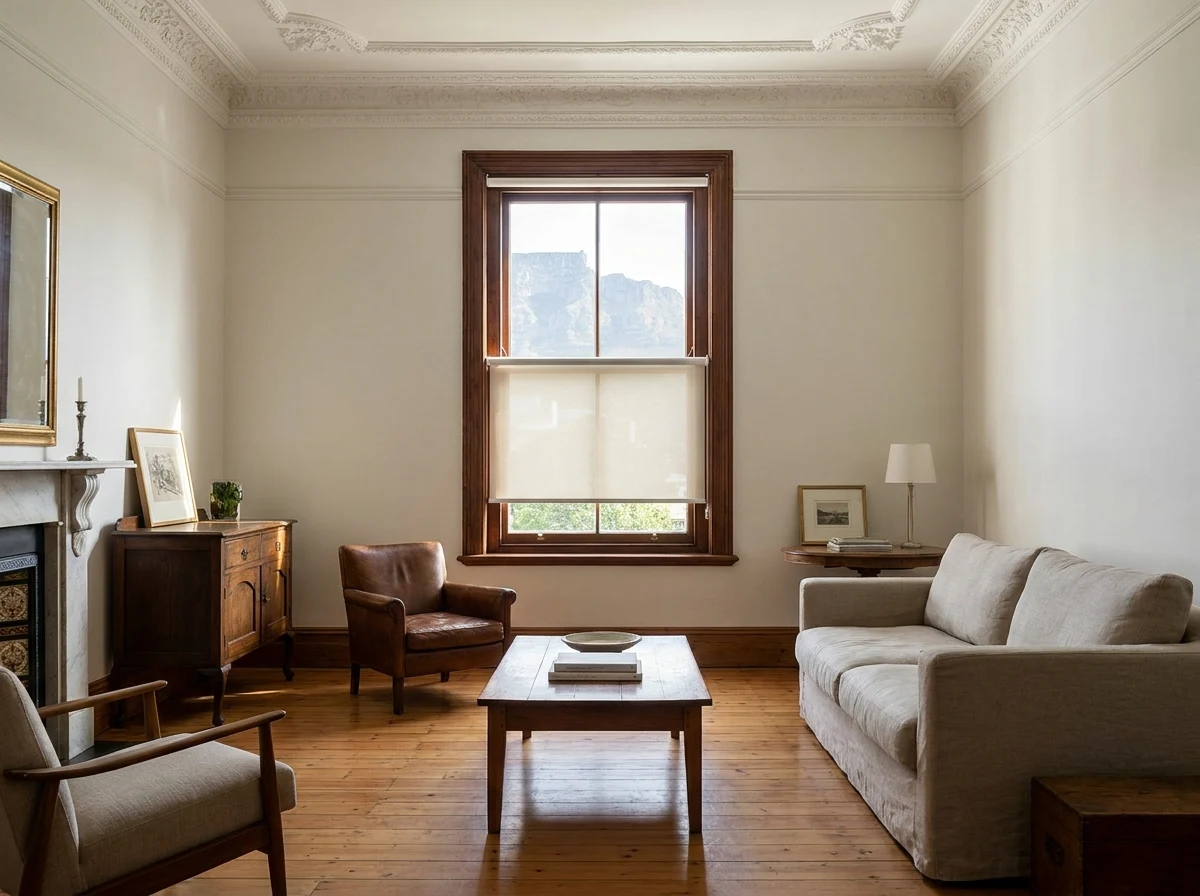
Sunscreen mesh. Woven open to a stated percentage — the tighter weaves cut more glare and hold more heat off the glass, the looser ones keep more of the city and the mountain. We put two or three openness levels against your own window and let you look through them before anything is ordered.
Bedrooms on the street side
Blockout. The coated cloth itself passes nothing; the light that wakes you comes down the edges. On a shallow Victorian reveal that usually means an outside mount with a deliberate overlap, or slim side channels where the frame allows them.
The glass extension at the back
Long drops need a thicker tube and a heavier cloth, or the fabric bows in the middle within a season. Wide openings are better split into aligned panels than hung as one exhausted roll. Motors earn their keep here more than anywhere else in the house.
Bathroom, scullery, stairwell
Wipeable fabric, sealed components and powder-coated brackets for the damp rooms; a wand, cordless spring or motor for the sash at the turn of the stairs that nobody can reach without a ladder.
Rooms that have to do both
A double roller carries sunscreen and blockout on one bracket, each on its own tube. Living rooms that double as guest rooms, north-facing studies, any window where the day answer and the night answer genuinely differ.
Seven things settled at the window, not at a desk
- Reveal width measured at top, middle and bottom — a hundred-year-old sash box is rarely square, and the narrowest of the three is what the blind is cut to
- Inside or outside mount, decided against the real reveal depth and the fixing surface in front of you rather than against a standard bracket
- Roll direction — a reverse roll carries the fabric clear of a deep sill, a sash lift or a casement stay that a standard roll would catch on
- Tube diameter and fabric weight sized to the drop, so a four-metre run in the extension is not specified like a bathroom window
- Head finish — open roll, fascia or full cassette — chosen against the cornice and architrave line, not left to whatever the bracket happens to look like
- The colour of the back of the fabric, which is what the street sees on a terrace facade — we keep the reverse consistent across an elevation even when the rooms behind it differ
- Operation: a child-safe chain tensioner fitted as standard wherever a loop stays, and a cordless, wand or motorised option offered wherever it does not
Nothing changes until you go outside the glass
The lower half of Oranjezicht, together with all of neighbouring Tamboerskloof, falls inside the City Bowl’s Heritage Protection Overlay Zone. Work fixed to the outside of a building older than sixty years can need a Heritage Western Cape permit before it starts. A roller fitted inside the reveal is a furnishing decision and sits outside that process entirely; an external screen channel or an awning cassette does not. We tell you which side of that line your job falls on at the measure, plainly, rather than treat an approval as a formality.
The second rule is weather. From October to March the south-easter accelerates through the bowl between the mountain and the sea, with gusts recorded up to roughly 160km/h over Table Bay, and an indoor roller fabric on indoor brackets is not built for that — outdoors we specify a zip screen running in side channels instead. Winter brings the opposite problem: roughly seventy per cent of the year’s rain falls between June and September, arriving on north-westerly fronts about every six days, which is why the damp south-side rooms get sealed components and corrosion-resistant hardware even though they never see the wind.
Roller blinds across the City Bowl
The same fabric arithmetic runs through the suburbs either side of us — architect glazing on the Higgovale slopes, iron-lace verandahs in Tamboerskloof, Company’s Garden apartments in Gardens, and the Vredehoek balconies that take the wind first.
What people ask us about rollers
Our lounge window is the view. What openness keeps it?
Sunscreen fabrics are sold by how open the weave is, and that number is a trade-off rather than a quality rating. A tighter weave takes out more glare and more heat but flattens the detail of what you are looking at; a more open one keeps the mountain crisp and does less about the four-o’clock sun. There is no universally correct figure. Hold two or three against your own glass, at the hour the room bothers you, and the choice usually makes itself inside a minute.
Can the old front rooms and the new extension take the same fabric?
Often the same fabric, almost never the same specification. A four-metre drop over extension glass needs a heavier cloth and a fatter tube than a 1.4m sash in the front room, even in an identical colour and weave. Keeping the colour consistent through the house is easy and worth doing; pretending the two windows are the same job is what leaves you with a sagging blind by the second summer.
Will a west-facing blind fade faster than the rest?
Yes, and it is worth planning for. The western elevation takes low, direct afternoon sun for hours, so anything on it ages faster than the same fabric on a southern window. We steer those openings towards fabrics with better light-fastness and away from the deepest dyes, and we say so up front rather than let you discover it three summers later.
Can you re-fabric the rollers we already have?
Sometimes. Where the brackets are sound and the tube is straight, replacing the cloth and the chain mechanism usually costs less than a new blind, and the consultant will say when that is the sensible route. Where the tube has bowed, or the previous fitting was cut short of the reveal in the first place, re-covering it only buys you a neater version of the same problem.
Is a motor worth it on an ordinary roller?
On a window you can reach comfortably, honestly not. It earns its place on high or awkward openings, on a run of blinds you want moving together, and on anything above a stairwell or a fixed piece of furniture. Battery motors retrofit to most existing brackets without cabling, so it is a decision you can take room by room instead of all at once.
Other things we fit in Oranjezicht
What a roller blind costs in Oranjezicht
Per square metre, installed: a chain-worked roller carrying solid, mesh or translucent fabric comes to about R1,000 to R1,600 per square metre. Standard blockout holds the lowest figure; a fine sunscreen mesh; a tight-openness sunscreen for a mountain-facing wall, or a two-layer blind on a single deeper bracket, sits at the upper. With a motor the same window sits between R2,500 and R3,800 for each square metre, covering the tube drive, the handset and the setting up.
Those figures are a guide to plan around, not a quotation. A small window carries a minimum charge, because the hardware and the fitting labour hardly change with the opening. Every opening is worked out one at a time at the measure, and you get it on paper.
Not sure which fabric your rooms need?
Start with the window that annoys you most. The free in-home measure is where a consultant reads the light at the hour it bothers you, holds samples against your own glass, and prices every opening in writing.
Tell us about your windows
Tell us which rooms you are looking at and roughly how many windows. One of our expert consultants will contact you shortly to arrange your free in-home measure.
- No obligation, no call-centre — a consultant calls you directly
- Fabric samples brought to the measure, not just a screen swatch
- Written, itemised quote before anything is ordered